

Blog
Motorcycle and ATV Lift Buying Guide: Fit, Capacity and Stability

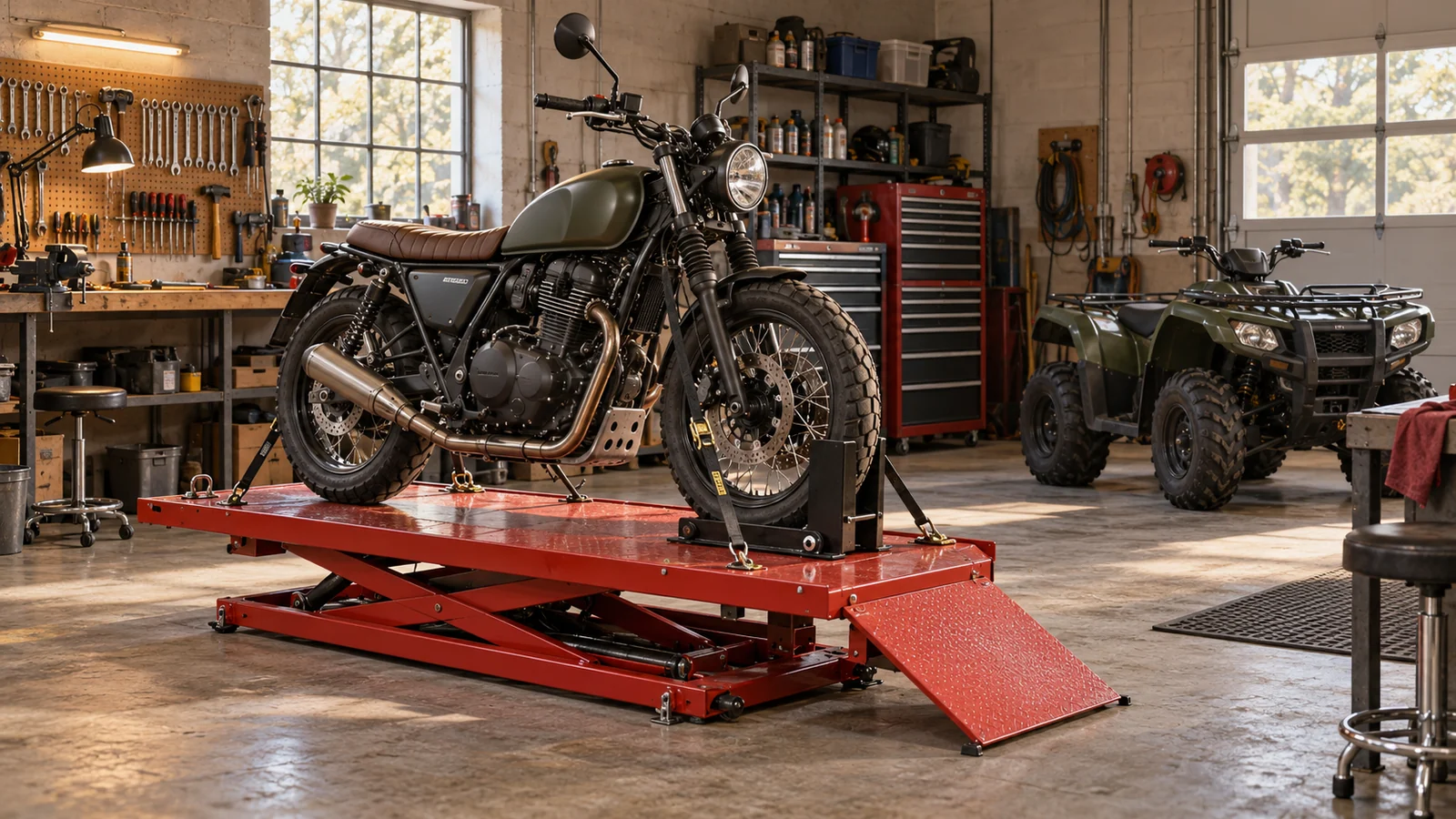
Choosing a motorcycle or ATV lift is a fit problem before it is a capacity problem. The lift must suit the vehicle’s weight, dimensions and support points, the work you intend to do, and the space available. A higher rating cannot compensate for an incompatible platform or an unsupported vehicle.
Motorcycle and ATV lift selection: start with the work
Write down the jobs you want the lift to make easier. Cleaning, general maintenance, wheel removal and work beneath the chassis can require different access. A table that supports the tires may be useful for some jobs but does not automatically leave the wheels free. A frame lift has a different support arrangement and must match the vehicle’s approved contact points.
Ask the manufacturer which service tasks the exact model and accessory combination permits. Do not treat a photograph of a motorcycle on a bench as proof that every wheel, suspension or engine job is supported. Accessories may change access, but they also introduce their own compatibility and load restrictions.
If one lift will serve several vehicles, list all of them. A motorcycle, ATV and side-by-side are not interchangeable simply because their weights fit below the same number. Confirm each vehicle type individually, and distinguish a service lift from equipment intended primarily for storage. Compare the iDEAL U-2200IEH-XR manufacturer’s manual with the motorcycle-bench documentation: each model has its own intended application and support arrangement.
Capacity is necessary, but it is not the whole answer
Get reliable weight information for the vehicle in the condition you intend to lift it. Account for fitted accessories, fluids and anything remaining on the vehicle; do not compare an unloaded brochure figure with a differently configured machine. If you cannot establish the relevant weight, resolve that before selecting equipment.
Compare that information with the manufacturer’s rated capacity and permitted loading conditions. Ask whether compatible accessory equipment contributes to the load, and check the accessory’s own rating. The lowest applicable limit matters. Do not rely on an invented universal percentage margin or assume exceeding one restriction is acceptable because another specification looks generous.
The Tuxedo M-1500C-HR manual illustrates why model-specific checking matters: it lists capacity alongside platform dimensions, operating pressure and safety requirements. A capacity figure is one entry in a complete selection brief, not permission to use the lift with any vehicle below that weight.
Build a motorcycle and ATV lift fit checklist
Measure the vehicle as configured, including accessories that affect its width or length. For a motorcycle, record wheelbase, tire dimensions, overall length and ground clearance. For an ATV, add tire track and overall width. A vehicle’s widest bodywork may not be where its tires or support points sit.
Compare those measurements with usable platform dimensions, not just the lift’s overall envelope. Ask how wheel stops, a vise, removable panels or side extensions affect the usable area. Confirm that extensions are approved for the exact lift and application; they do not automatically increase the lift’s rated capacity.
| Check | Motorcycle | ATV or side-by-side |
|---|---|---|
| Vehicle fit | Wheelbase, tire size, overall length and accessories. | Wheelbase, tire track, overall width and accessories. |
| Support method | Approved wheel restraint or compatible frame contacts. | Approved wheel-support layout or frame contacts. |
| Service access | Access needed for the specific maintenance job. | Access needed without unsupported overhang or improvised adapters. |
| Space | Platform, ramp, controls and access around the vehicle. | Wider vehicle envelope, ramps, controls and surrounding access. |
Check the full loading approach too. A low motorcycle can clear the table yet interfere with a ramp transition. A wide ATV may need a different approach arrangement. Resolve compatibility through the manufacturer’s instructions rather than improvising extra ramps or using loose blocks to make the fit work.
In the workshop, mark the lift’s complete footprint and loading area before ordering. Include room for the operator, controls and the work itself. Check overhead obstructions using the intended raised vehicle envelope; the table’s raised height alone does not describe the height of the vehicle sitting above it.
Treat restraint and mechanical support as separate checks
A vehicle can be within the capacity rating and still be unsuitable for the support arrangement. Ask about the approved restraint equipment, where it attaches and whether it is supplied. A wheel vise, chock or tie-down point should not be mistaken for a complete universal restraint solution.
Read how the manufacturer describes the lift’s mechanical support or locking features and the required checks before use. The Tuxedo manual includes both vehicle-securing requirements and a locking-bar requirement. Those are distinct systems: keeping a motorcycle upright and supporting the raised lift are different concerns. This buying guide does not replace the operating sequence in the manual.
Look for a clear answer to what is included, what is optional and which combinations are approved. Ask for written clarification if product wording and the manual appear inconsistent. Never assume an attachment from another brand or an improvised adapter preserves compatibility. Any proposed modification needs manufacturer review, not a guess based on appearance.
Check utilities, workspace and long-term support
Determine whether the chosen lift uses compressed air, electricity or another specified power source. Confirm the exact requirements and available services with the appropriate qualified provider. Do not assume every motorcycle lift needs a compressor, or that a nearby outlet is suitable simply because a product is described as electric.
Review the selected model’s floor, environment and installation requirements before buying. Avoid transferring passenger-car lift anchoring rules to a motorcycle bench or assuming a freestanding design can be used on any surface. The manual and a qualified installer should resolve location requirements, not a generic slab specification from a blog.
Check access to manuals, replacement parts and maintenance information. Ask who supports the particular model and how to identify its serial number. Consumables, accessories and regular inspections belong in your ownership plan even when the lift itself fits the available space.
Plan arrival separately. Riggmont includes free shipping and liftgate unloading across all 50 U.S. states; inside placement, assembly and installation are not included. The total delivery window is 7–11 business days: 2–3 business days for handling and 5–8 business days in transit. Review Shipping and Delivery before coordinating an installer.
Frequently asked questions
Can a motorcycle lift support an ATV?
Only when the exact lift and accessory configuration are approved for that vehicle. Capacity alone does not establish platform width, tire support, restraint or loading compatibility.
Do side extensions increase lifting capacity?
Do not assume so. Check the lift and extension documentation for their separate limits and permitted use; extra surface area is not automatically extra load capacity.
What should I send when asking for a recommendation?
Send the vehicle make and model, configured weight, key measurements, intended jobs and workspace dimensions. Include utility availability and any access constraint that could affect delivery or installation.
Compare lifts with your measurements in hand
Browse Motorcycle and ATV Lifts, then send your selection brief to sales@riggmont.com. Call +1 (478) 758-4153, Monday–Friday, 9 a.m.–5 p.m. ET. For existing orders, use Riggmont support.