

Blog
2-Post vs 4-Post Car Lifts: Which Fits Your Work?

Riggmont buying guides
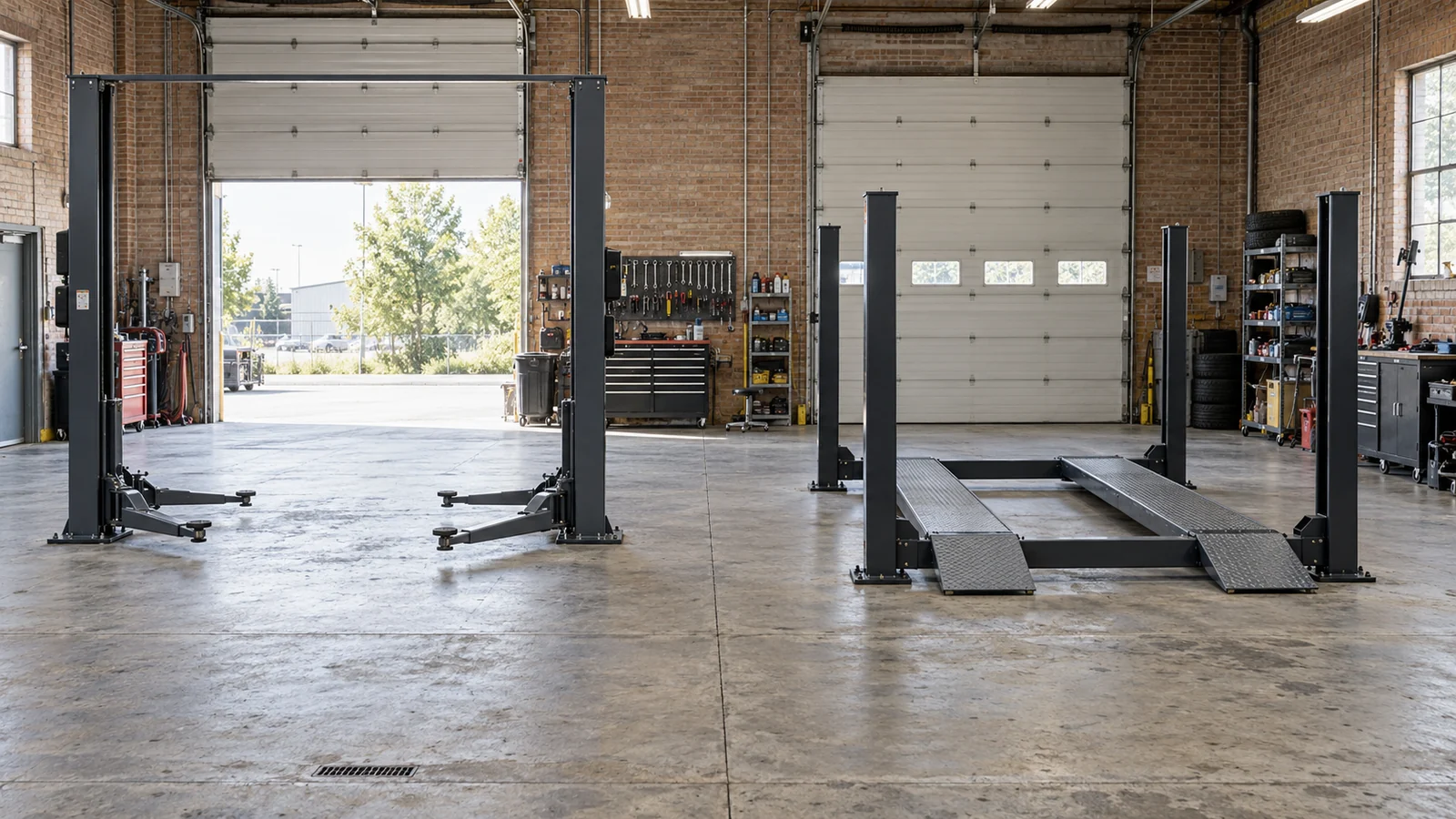
Choose a two-post car lift when routine wheels-off service is the main job. Start with a four-post car lift when drive-on access or manufacturer-approved vehicle storage matters more. A four-post lift can support wheels-off work with an appropriate approved jacking accessory, but that changes the equipment list and workflow. Neither design is automatically the right choice for every vehicle or garage.
The useful comparison is not simply two columns versus four. It is how the vehicle is supported, which areas you need to reach, and whether the exact model can be installed and used correctly at your site. This guide compares buying decisions; it does not replace installation instructions or operator training.
2-post vs 4-post car lifts at a glance
| Buying question | Two-post lift | Four-post lift |
|---|---|---|
| How is the vehicle supported? | Arms and adapters contact specified lifting points | Tires rest on drive-on runways |
| What about wheels-off work? | Wheels are normally free when correctly lifted | Requires a compatible approved jacking arrangement |
| What must match the vehicle? | Arm reach, adapter contact, clearance and load distribution | Runway geometry, wheelbase, tire position and load distribution |
| Is storage suitable? | Do not assume storage approval | Investigate models expressly intended for storage |
| Can the existing floor be used? | Needs model-specific site assessment | Also needs model-specific site assessment |
| What is the total cost? | Lift plus required site work, installation and accessories | Same categories, with jacking accessories if needed for the work |
The linked two-post manual and four-post manual show why the full model specification matters. They describe particular products, not every lift in either category, and are references rather than inventory recommendations.
Choose by service access, not just lifting height
Two-post: start here for regular wheels-off service
For frequent tire changes, brake service or suspension work, having the wheels clear without adding a separate runway jack is a practical reason to investigate two-post lifts. The trade-off is vehicle positioning and contact-point compatibility: the arms and adapters must work with the vehicle manufacturer’s designated lifting points.
Picture your normal tools and work sequence. Can your intended equipment approach the area being serviced? Will a lift arm interfere with a planned component removal? The suitability of a lift for raising a vehicle does not automatically approve every repair procedure. Consult both the lift instructions and vehicle service information when a job changes weight distribution.
Four-post: start here for drive-on use and suitable storage
A four-post lift carries the vehicle on runways. That makes it a useful category to investigate when you want drive-on access rather than positioning frame-engaging arms. The runways remain part of the working environment, so compare their position with the areas you need to reach.
For wheels-off work, identify the exact approved bridge or rolling jack, its own capacity and its compatibility with the lift and vehicle. Do not assume the jack has the same rating as the lift. Ask whether the intended job requires additional equipment; a quote for a bare drive-on lift may not represent a complete brake-service setup.
For parking, verify storage suitability in writing. Check the proposed raised position and the clearance for the lower vehicle as well as the upper vehicle. Do not turn “four-post” into a blanket promise that two cars will fit in any garage.
Capacity does not settle vehicle compatibility
Compare each candidate with a list of the vehicles you actually intend to use. Include relevant weights, dimensions, modifications and OEM lifting information. A short sports car, long pickup and battery-electric vehicle can present different geometry even if all appear to fit beneath the same headline capacity.
For two-post equipment, check permitted loading, per-arm limits where specified, arm reach, pad height and approved adapters. For four-post equipment, check axle-load and wheelbase conditions where specified, runway dimensions and approach requirements. Total capacity does not cancel these other limits.
Do not select a lift by adding a generic safety percentage to vehicle weight and stopping there. Ask the manufacturer or supplier to confirm the actual vehicle configuration against the complete specification. If you do not know the loaded weight or lifting points, resolve the uncertainty before buying.
ALI’s buying guidance highlights capacity, clearance, lifting-point access and approved accessories. Its operator guidance also makes clear that vehicle positioning and correct accessories matter. These are reasons to seek model-specific training, not to rely on a category label as a safety guarantee.
Compare the garage fit and installation scope
A two-post lift is not automatically the better small-garage choice. A four-post lift is not automatically easier to accommodate. Compare drawings for the actual candidates and include posts, ramps, power unit, controls and required clearances. Then add the space the vehicle and your work need.
Measure the garage door, tracks and opener through their operating path. Include beams, lights and shelving on your sketch. Compare the intended raised position, not only the published maximum rise. There is no universal ceiling-height rule that resolves all vehicle and lift combinations.
Consider approach and daily access. Can the vehicle enter without an awkward turn? Can you reach the controls, leave the garage and open necessary doors? If you plan to alternate vehicles, repeat the layout check for each one rather than designing only around the smallest car.
Both lift types require a suitable supporting surface. Some four-post designs have particular anchoring provisions, but that does not make every four-post installation foundation-free. A qualified installer should compare the exact manual with the slab, including its condition and any unknown construction details. Never assume a generic concrete thickness approves a site.
Ask a qualified electrician to assess the candidate power unit and required supply. Do not assume post count determines voltage or circuit requirements. Have any building, permitting and electrical questions resolved with the appropriate local professionals. This comparison deliberately provides no DIY drilling, anchoring or wiring instructions.
Compare complete cost, certification and ownership
Ask for two itemized quotes based on the same work requirement. Include the lift, required approved accessories, delivery handling, installation, electrical work and any site remediation. If one quote includes a wheels-off accessory and another does not, the headline totals are not equivalent.
Separate necessities from conveniences. Adapters required for your vehicle belong in the purchase decision now; optional accessories for a job you may never do can wait. Ask who will supply parts and service, what documentation accompanies the equipment, and who handles commissioning and operator training.
Certification must also be model-specific. Use the ALI Directory of Certified Lifts to verify any ALI claim for the exact designation being quoted. A brand’s participation, an electrical component’s listing or another model’s label is not confirmation that your candidate is certified.
Plan inspection and maintenance with either design. ALI’s inspection guidance calls for at least annual inspection by a qualified lift inspector, alongside the applicable manufacturer instructions. Ask the installer how inspection and service access will work in your location. Do not choose either design on the assumption that it is maintenance-free.
A decision checklist for your shortlist
- Mostly tires, brakes and suspension? Start with two-post candidates and verify lifting-point access.
- Mostly drive-on tasks or parking? Start with four-post candidates and verify the intended use.
- Need both storage and wheels-off service? Compare a suitable four-post model with its approved jacking setup against your actual workflow.
- Mixed vehicles? Check each vehicle individually against every loading and dimensional limit.
- Tight garage? Request a model-specific layout with door movement and working space shown.
- Uncertain floor or power? Obtain professional site assessment before placing the order.
If both designs pass these checks, prioritize the task you perform most often. If neither passes, revisit the layout or investigate another lift type rather than relaxing a manufacturer requirement.
Frequently asked questions
Is a four-post lift safer than a two-post lift?
Post count alone does not establish safety. Correct selection, installation, vehicle compatibility, training, inspection and operation all matter. Compare the exact models and documentation rather than treating either design as safe regardless of its application.
Can you remove wheels on a four-post lift?
Yes, when the lift and vehicle are compatible with an appropriate manufacturer-approved jacking arrangement used as instructed. Confirm that accessory’s rating and fit separately; the lift’s total capacity is not the accessory’s capacity.
Which lift takes up less room?
There is no reliable category-wide answer. Compare installed drawings, ramps, vehicle approach, door clearance and working access for the exact candidates. The smallest published footprint may not produce the most usable garage.
Compare the right models for your work
Explore Riggmont’s two-post lifts and four-post lifts. Send your vehicle details, intended tasks and garage measurements through contact Riggmont or email sales@riggmont.com for buying questions. Request model documentation and a clear accessory list before deciding.