

Blog
Car Lift for a Home Garage: A Practical Buying Guide

Riggmont buying guides
The best car lift for a home garage is the one that matches your work, your vehicles and a professionally verified installation site. Start with a two-post lift for frequent wheels-off service, or a four-post lift when drive-on access and vehicle storage are the priority. Neither choice is ready to order until you confirm the exact model’s dimensions, loading limits, foundation requirements and power supply.
This guide helps you build a useful shortlist without relying on a universal ceiling height or concrete rule. It is a buying guide, not an installation or operating manual. The manufacturer’s current instructions, the vehicle’s lifting information and qualified site assessment govern the final decision.
Choose a car lift for your home garage by the job
Write down your three most common tasks. Changing tires every season, restoring suspension and parking a second vehicle are different requirements. A lift that makes one convenient may add equipment or extra handling to another.
| Main use | Type to investigate | What to verify |
|---|---|---|
| Frequent brake, tire or suspension work | Two-post | Approved lifting points, arm reach and adapter compatibility |
| Drive-on access and parking | Four-post | Storage permission, runway fit and clearance for both vehicles |
| Limited overhead space or occasional service | Low-rise, mid-rise or portable designs | Actual working access, lifting height and vehicle support requirements |
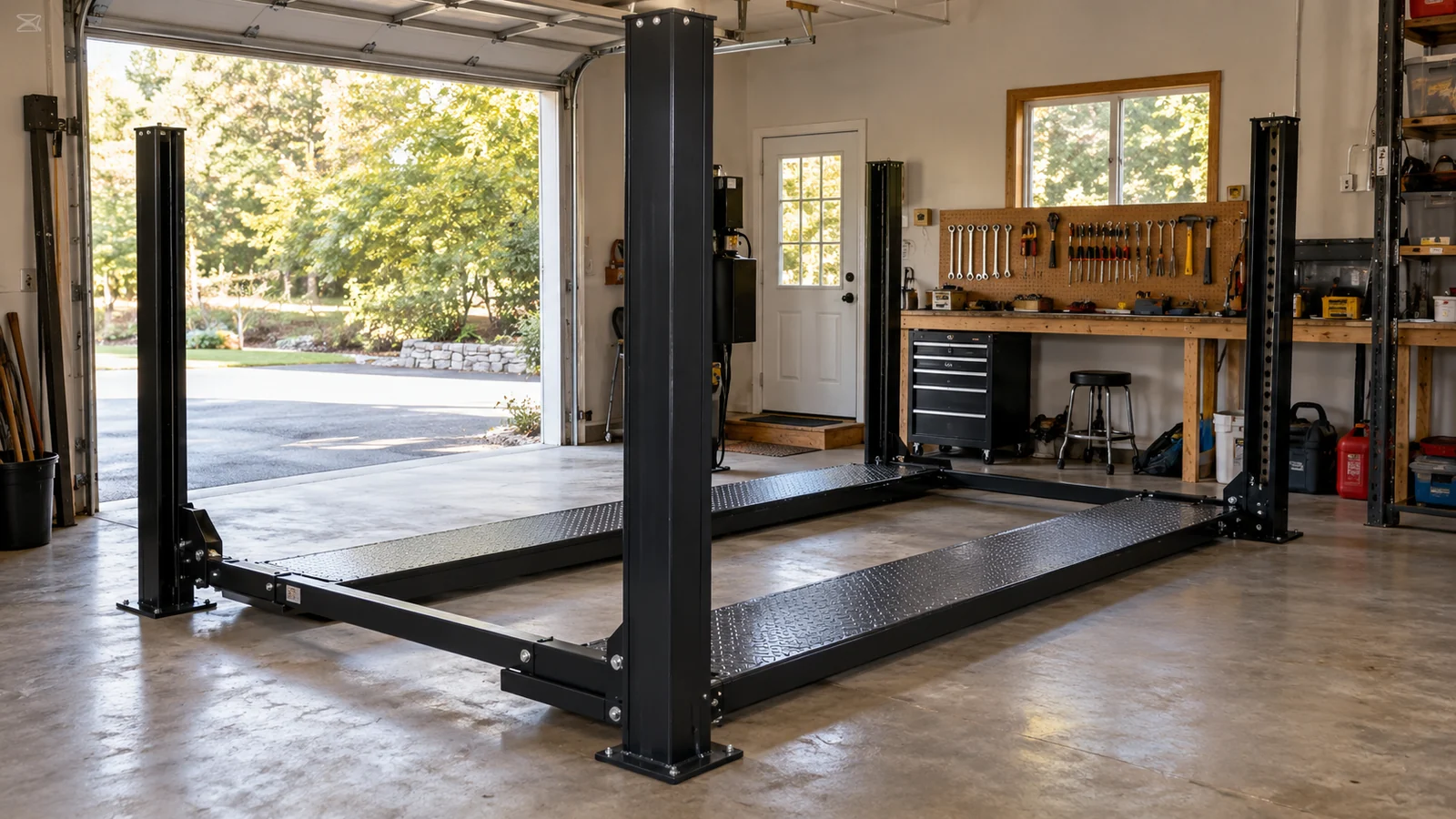
A frame-engaging two-post design supports the vehicle at designated points and leaves the wheels free. A conventional four-post design supports the tires on runways; wheels-off work needs a suitable, manufacturer-approved lifting accessory. Check the manufacturer’s two-post manual and four-post manual for examples of these different arrangements, not specifications for every lift.
If parking is the primary goal, ask explicitly whether the candidate is intended for that use. Do not assume every service lift is a storage lift. If working underneath is the primary goal, compare usable access with your tools and intended procedures rather than simply comparing maximum rise.
Check capacity and vehicle compatibility together
Make a vehicle sheet with year, make, model, wheelbase, tire dimensions, ground clearance and relevant weight information. Include modifications and the heaviest configuration you expect to lift. Do not substitute towing capacity or payload for the vehicle’s actual lifting load. If the weight is uncertain, resolve it before selection.
The rated capacity is only one limit. A model may also specify axle loads, per-arm loads, permitted load distribution or wheelbase conditions. A vehicle being lighter than the headline capacity does not establish compatibility. Do not create a universal percentage “safety margin” and treat it as a substitute for these limits.
For two-post candidates, ask whether the arms and approved adapters can reach the vehicle manufacturer’s specified lifting points without interference. For four-post candidates, confirm tire position, runway dimensions and approach clearance. A lowered car deserves particular attention to the ramp transition; a long vehicle needs more than an overall bay-length check. ALI’s lift-buying guidance emphasizes matching the lift, vehicle and approved accessories.
Electric vehicles and modified trucks should be evaluated using their specific lifting information. Share the vehicle documentation with the lift supplier and installer rather than assuming a familiar body shape means familiar lifting points. Also list any future vehicle you genuinely expect to own; avoid paying for hypothetical capability you have not defined.
Measure the garage as an operating space
Prepare a dimensioned sketch, not just a ceiling measurement. Record bay width and depth, door opening, ceiling obstructions, shelving, lights, beams, opener and door-track positions. Note how the door travels when opening. A location that looks clear with the door closed may not remain clear during use.
Then compare the sketch with the exact lift’s dimensional drawing. Include posts, power unit, ramps, controls and the vehicle’s movement into position. Leave the required clearances from the manual and space to walk, operate controls and bring equipment alongside the vehicle. Do not use another owner’s garage photo as dimensional evidence.
There is no single ceiling-height answer for every home-garage car lift. The useful height depends on the candidate lift, the vehicle, the intended raised position and everything above it. For stacked parking, have the installer check the raised vehicle, platform or runway assembly, lower vehicle and door movement as one layout. Maximum lift rise alone cannot answer that question.
Ask for a proposed working layout before you commit. Consider ordinary access too: can you open the vehicle door, reach storage and use the garage entrance with the lift occupied? A lift can physically fit yet make the room awkward for your daily routine.
Verify concrete, electrical supply and safety documentation
A finished floor does not reveal the slab’s construction or condition. Give the qualified installer the candidate manual and whatever foundation records you have. Have unknown thickness, strength, reinforcement, cracks, joints, slope or embedded services assessed as needed. Model-specific requirements decide suitability; neither “residential concrete” nor a generic thickness is approval.
Do not assume a four-post lift eliminates foundation checks. Whether anchoring is required and what floor conditions are acceptable depend on the exact model and installation. Post-tensioned or otherwise uncertain slabs warrant professional evaluation before any proposed drilling. This article intentionally gives no anchor layout or drilling instructions.
Similarly, provide the electrician with the actual power-unit specification and installation manual. Confirm the required supply and any associated electrical work before purchase. Do not choose from a casual “household power” description or copy another model’s wiring arrangement. The linked manufacturer manuals contain their own installation requirements; they are not interchangeable.
For certification, search the exact manufacturer and model in the Automotive Lift Institute directory. A certification statement about a motor, a brand logo or an unrelated model does not verify the complete lift you are considering. Keep the model designation and supporting documentation with your quote.
Budget for the complete usable setup
Request an itemized quote covering the lift, required approved adapters or jacking accessories, delivery arrangements, installation and electrical work. Identify possible site remediation separately. Ask who provides each service and what happens if the installer finds the site unsuitable.
Plan the delivery route from the unloading location to the installation bay. Confirm packaging dimensions, handling arrangements and access restrictions with the supplier. Delivery and unloading are not the same thing as moving, assembling and commissioning equipment inside your garage.
Include ownership responsibilities in the decision. Ask about access to service personnel, replacement parts, manuals, training and inspection. ALI’s inspection guidance calls for at least annual inspection by a qualified lift inspector; the manufacturer’s maintenance and pre-use requirements still apply. A certification label is not a substitute for those checks.
Before-you-buy checklist
- Use: List your main service tasks and whether vehicle storage is required.
- Vehicles: Supply dimensions, relevant weights and OEM lifting information.
- Fit: Compare loading limits, arm or runway geometry and required accessories.
- Space: Map the lift, vehicles, door movement and operating clearances.
- Site: Obtain qualified foundation and electrical assessments for the selected model.
- Documentation: Check the current manual, certification claim and written scope.
- Handover: Agree on installation, commissioning, training and ongoing support responsibilities.
Frequently asked questions
What is the best car lift for a small home garage?
Start with the work and vehicle, then compare the complete installed footprint and operating envelope. A smaller lift is not automatically compatible, and reduced rise can limit working access. Have the exact layout reviewed before ordering.
Can I install a car lift on my existing garage floor?
Possibly, but appearance alone cannot establish suitability. A qualified installer must assess the slab against the selected lift’s requirements and arrange any additional evaluation needed. Do not assume an existing slab is acceptable for every lift type.
Should I buy a two-post or four-post lift for home use?
Begin with two-post options for regular wheels-off work and four-post options for drive-on convenience or approved storage use. Then compare vehicle compatibility, space and installed scope. Neither category wins if the chosen model does not fit your site.
Build a shortlist that fits your garage
Browse two-post car lifts and four-post car lifts, then contact Riggmont with your vehicle sheet, garage sketch and intended work. For buying questions, email sales@riggmont.com. Ask for the exact model’s manual and specifications before making your final choice.